

How to Choose a Polypropylene Filter Cartridge for Pharmaceutical Pre-Filtration
How to Choose a Polypropylene Filter Cartridge for Pharmaceutical Pre-Filtration
Choose the Polypropylene Cartridge Around the Pre-Filtration Duty
A polypropylene filter cartridge can be a practical choice for pharmaceutical pre-filtration when its pore-size range, fluid compatibility, pressure and temperature conditions, sterilization method, and physical format match the process.
The right choice is not simply the smallest nominal pore size. Start with what the pre-filter must remove, how much fluid it must process, what pressure drop the system can tolerate, and whether the element will be cleaned, sterilized, or replaced.
For a buyer preparing an RFQ, the key question is whether the proposed PP cartridge is suitable for the specific upstream duty. A product family such as the HPP polypropylene cartridge family can provide a starting point, but the final selection still needs the fluid, operating conditions, cartridge dimensions, and documentation requirements written into the request.
Define What the Pre-Filter Must Do
State whether the cartridge protects a downstream sterilizing-grade filter, removes larger particles before a finer step, protects a pump or instrument, or conditions a process stream. The pre-filter’s job determines how to weigh dirt-holding capacity, pressure drop, throughput, cleanability, and replacement frequency. A cartridge selected only by micron label may be undersized for the load or unnecessarily restrictive for the process.
Separate Liquid, Gas, and Solvent Service
Polypropylene selection depends on the service. A liquid pre-filter, a compressed-gas filter, and a solvent step can require different media, wetting behavior, seals, pressure direction, and sterilization review. Make the service explicit before comparing materials. Do not transfer a liquid-filtration conclusion to gas or solvent duty without a written compatibility assessment.
Compare Pore Size With Process Risk, Not in Isolation
Pore size is an important screening field, but it does not describe the complete performance of a cartridge. The buyer also needs to consider particle loading, fluid viscosity, temperature, available pressure, required throughput, and the downstream step that the pre-filter protects.
Use the Pore Size to Define the Separation Task
Write the target particle or contamination-control objective in the RFQ before choosing a nominal pore size. If the cartridge is a guard filter, its job may be to protect a finer downstream membrane rather than to provide the final retention step. If the process requires a validated sterilizing-grade barrier, do not assume that a PP pre-filter can replace that barrier. Ask the supplier to identify the intended filtration role and any separate downstream requirement.
Check Pressure Drop and Flow Together
A cartridge that meets a pore-size target can still be a poor process fit if pressure drop rises too quickly. Ask for the test conditions behind any flow or pressure-drop information, including fluid, temperature, cartridge area, and endpoint.
Compare normal and peak flow, batch volume, and allowable differential pressure. This gives engineering a usable basis for deciding whether the element needs more area, a different structure, or a different pre-filtration stage.
Consider Particle Load and Replacement Practice
Pre-filtration is often a service-life decision. A high-load stream may consume a cartridge quickly even when the initial flow looks acceptable. Record the expected solids burden, batch size, changeout trigger, disposal route, and spare-element plan. These details help purchasing compare cost per batch rather than only price per cartridge.
Evaluate HPP Polypropylene Cartridge Fit
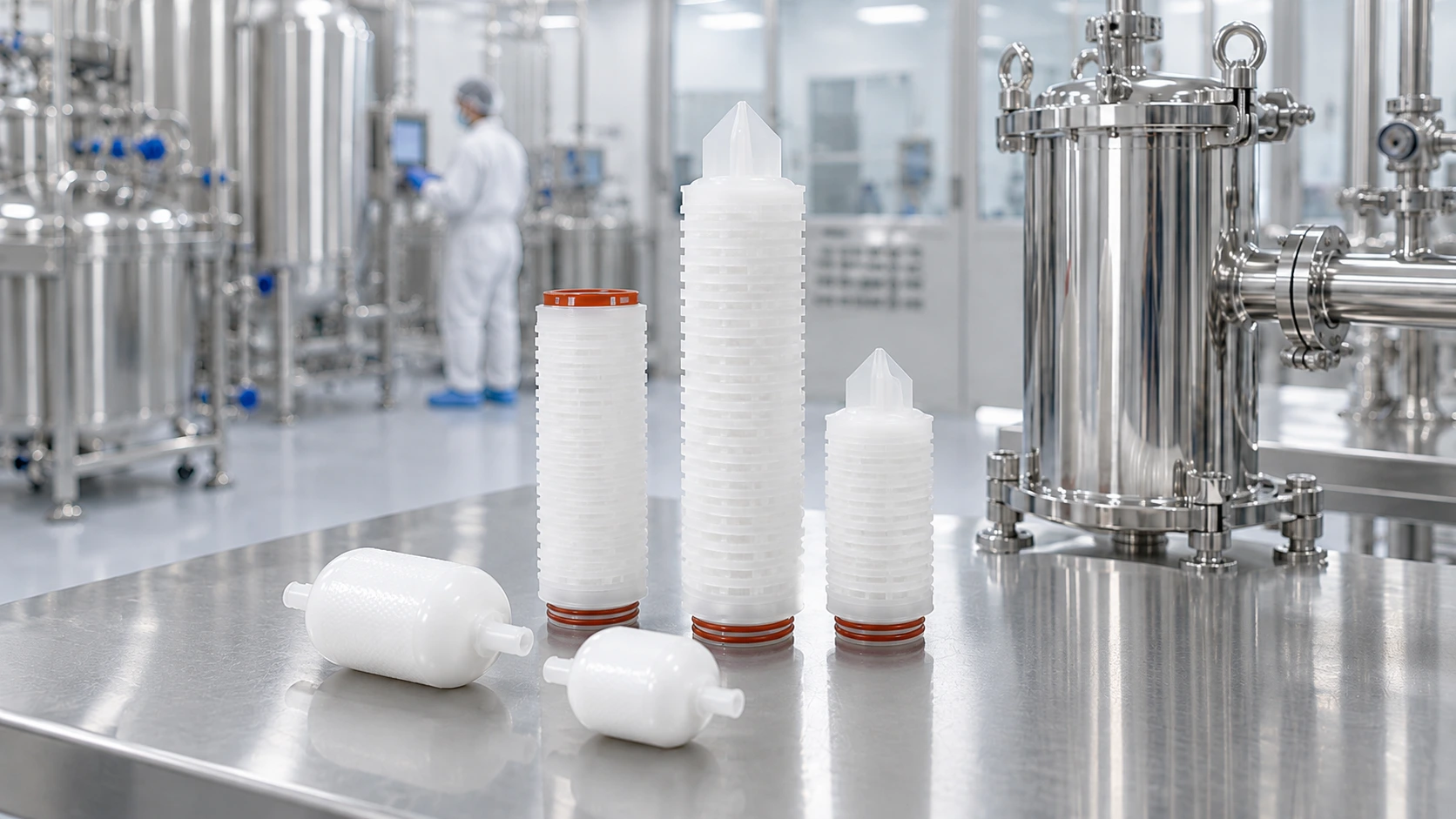
MedIntegrity’s HPP product information describes a PP filter medium, a complete PP construction with a melting process, a range of filtration precisions, and use in pre-filtration and precise filtration applications. It also lists fields for pH, working temperature, pressure difference, sterilization temperature, and related product families.

The HPP page also addresses concerns that matter in pre-filtration: a hierarchical depth structure, resistance to fiber shedding, chemical-cleaning considerations, and use with some pharmaceutical and process fluids. Use these published characteristics as the starting point for confirming the HPP configuration that best matches the application.
Ask which construction, length, end style, and operating limits apply to the proposed cartridge, and request written confirmation for the actual fluid and sterilization cycle.
When HPP or PP Is a Reasonable Starting Point
HPP or PP is a reasonable starting point when the process needs a polypropylene depth-style element for pre-filtration, the fluid is compatible with the material and seals, and the pressure, temperature, and sterilization conditions fit the offered configuration.
When to Compare PES Instead
A hydrophilic PES membrane may be more relevant when the process centers on aqueous liquid filtration, low protein binding, or a defined membrane-filtration step. The PES membrane options provide a separate comparison path.
When choosing between PP and PES, a comprehensive comparison should be made regarding the application, retention requirements, fluid characteristics, pressure drop, sterilization conditions, and validation data.
When PTFE Needs a Separate Review
Gas and solvent filtration can require a hydrophobic PTFE discussion rather than a liquid pre-filter discussion. The PTFE gas and solvent cartridge information includes service-specific questions around hydrophobicity, liquid intrusion, chemical compatibility, and sterilization.
Build a Polypropylene Filter Cartridge RFQ
A clear RFQ lets suppliers respond to the same application instead of guessing from the phrase pharmaceutical PP filter. Include enough information to connect the cartridge to the process, the downstream protection objective, and the buyer’s quality review.
| RFQ field | Buyer input or question | Why it matters |
| Filtration role | Guard, pre-filter, pump protection, or other duty | Sets the performance and replacement objective |
| Fluid and chemistry | Fluid name or class, pH, solvent content, temperature | Supports material and seal compatibility review |
| Pore-size task | Target particle or downstream protection requirement | Prevents micron rating from becoming the only criterion |
| Flow and pressure | Normal/peak flow, batch volume, allowable differential pressure | Supports area and service-life comparison |
| Sterilization and cleaning | Steam, autoclave, chemical cleaning, or single use | Connects the element to the real cycle |
| Physical format | Length, diameter, end style, connector, quantity | Confirms fit in the housing or capsule format |
| Quality records | Batch traceability, test records, material documents, change notice | Defines what purchasing and QA must receive |
Ask for Conditions Behind Published Numbers
A pressure or temperature figure is useful only with its test basis. Ask for the exact cartridge configuration, fluid, temperature, pressure direction, and sterilization condition attached to the number. This is especially important when comparing quotations from different suppliers or moving from a laboratory trial to a production batch.
Confirm Whether the Cartridge Is the Final Barrier
A pre-filter and a final sterilizing-grade filter have different jobs. State the downstream filter or process barrier in the RFQ and ask the supplier to describe the proposed PP element’s role. This prevents a buyer from treating a depth pre-filter as a substitute for a validated final barrier or from assigning it a claim the product was not selected to support.
Quality, Traceability, and Change Control
For a pharmaceutical filter cartridge, quality review extends beyond the material name. Ask how the offered cartridge is identified by batch, what documents accompany it, how changes are communicated, and which tests or release records are available for the exact configuration.
For the selected HPP cartridge, ask MedIntegrity to confirm the available batch identification, material documentation, test or release records, and change-notification information. Use the supplier’s confirmed documentation as part of the buyer’s qualification and quality-review process.
The buyer should also define what happens when the cartridge, membrane, seal, supplier site, or manufacturing process changes. A change notification does not automatically prove equivalence, and an identical nominal pore size does not remove the need for technical assessment. Link the supplier response to the site’s change-control and verification process.
결론
Choose a polypropylene filter cartridge for pharmaceutical pre-filtration by starting with the duty: what the element protects, what the fluid contains, how much must be processed, and what pressure, temperature, cleaning, and sterilization conditions apply. Then compare pore-size task, pressure drop, service life, physical fit, traceability, and the documents required for approval.
For an application review, submit the fluid, pH or solvent information, flow, batch volume, temperature, pressure, sterilization method, cartridge dimensions, downstream filter, and quality-document requirements through the MedIntegrity product inquiry form. A complete application description is more useful than a request for a generic PP cartridge price.
FAQ는
Is a polypropylene filter cartridge suitable for pharmaceutical pre-filtration?
It can be suitable when the polypropylene construction, pore-size task, fluid, seals, pressure, temperature, and cleaning or sterilization conditions match the process. The cartridge should be evaluated as a pre-filter or guard element unless the buyer has separate evidence for a final barrier claim.
What is the difference between a PP pre-filter and a PES membrane filter?
A PP pre-filter is often considered for depth-style particle loading and upstream protection, while PES is a hydrophilic membrane option for defined liquid-filtration duties. The better choice depends on the separation task, fluid, pressure drop, sterilization, and verification basis rather than the material name alone.
How should pharmaceutical buyers compare PP filter cartridge pore sizes?
Tie the pore-size field to the particle or downstream-protection objective, then compare flow, pressure drop, particle load, batch volume, and service life. A smaller nominal rating is not automatically better if it causes excessive pressure drop or shortens the useful batch life.
Can a PP cartridge be used for solvent or gas filtration?
Not automatically. Solvent and gas service require a separate review of chemical compatibility, hydrophobicity or wetting behavior, pressure direction, seals, liquid intrusion risk, and sterilization. A PTFE option may be more relevant for some gas or solvent duties, but the exact application still needs written confirmation.
What documents should be requested for a pharmaceutical PP cartridge?
Request the exact configuration, material and seal information, operating conditions, sterilization compatibility, batch identification or traceability, available test or release records, change-notification process, and any documents required by the site’s quality system. Keep open questions visible until the supplier answers them in writing.


 Korean
 English
 Russian
 Spanish
 Portuguese
 German
 French
 Italian
 Arabic
 Dutch
 Japanese
 Vietnamese
 Malay
 Thai