

Prefilled Syringe Leak Testing: Packaging Leak Tester Guide 2026
Prefilled Syringe Leak Testing: Packaging Leak Tester Guide 2026
As GLP-1 injectable portfolios grow, prefilled syringe integrity is becoming a more visible quality and equipment-selection issue for pharmaceutical manufacturers. QA, validation, packaging engineering, and procurement teams need more than a low leak-size figure on a datasheet. A Verpackungsleckagetester has to work with the actual PFS configuration, deliver repeatable results under defined conditions, and fit the site’s tooling, data, and throughput requirements. GLP-1 remains a current topic in the 2026 prefilled-syringe industry agenda, including dedicated GLP-1 sessions at PDA’s 2026 conference.
For buyers evaluating prefilled syringe leak testing, the decision starts with the package itself and then moves to method suitability, ISO 11040-8:2026, tooling flexibility, total cost of ownership, and supplier support. MedIntegrity focuses on precision testing instruments and related solutions for the pharmaceutical industry, including pharmaceutical packaging integrity testing equipment.

Why GLP-1 Packaging Programs Raise PFS Integrity Requirements
Changes in syringe geometry, closure configuration, fill condition, or production volume can alter both the test setup and method performance. That becomes important when one platform is expected to support several PFS products rather than a single package format. Before comparing equipment, the first question is which package variables can change the result.
Key Parameters That Affect PFS Leak Testing Performance
A finished PFS is not a generic test piece. Barrel geometry, plunger position, front-end closure, headspace, fill condition, chamber volume, stabilization time, and method parameters all affect how a leak testing method performs.
The target also needs to reflect the package-integrity requirement or maximum allowable leakage limit (MALL), rather than simply the smallest defect size listed for the instrument.
That is why a feasibility run with representative samples usually tells a procurement or validation team more than comparing 1 μm, 1.5 μm, and 5 μm claims side by side. Published micron figures are useful for initial screening, but they are not automatically equivalent across different packages, contents, test chambers, and method settings. Sepha, for example, qualifies its Multi-Q HD 1 μm capability by container type and contents.
Once the package variables and target leakage requirement are defined, the next decision is which test principle can produce a stable, repeatable method for that application.
Vacuum Decay for PFS Leak Testing: Where It Fits
Vacuum decay is a non-destructive, deterministic approach widely used in pharmaceutical container closure integrity testing. A package is placed in a fitted chamber, vacuum is applied, and pressure behavior is measured over a defined test period. Chamber design and package characteristics remain important because they influence the signal generated by a leak.
For buyers, the point is not simply that vacuum decay is available. It is whether the method can be developed around the actual PFS and its target leakage requirement.
If your team wants a broader equipment-selection reference, MedIntegrity also has a guide on how to select a packaging leak tester for pharmaceutical production.
Technical feasibility answers whether a method can work on the package. The next part of the buying decision is how that method fits within current requirements for finished prefilled syringes.
ISO 11040-8:2026 and Finished Prefilled Syringe Testing
ISO 11040-8:2026 is the current second edition of the standard for finished prefilled syringes. Published in June 2026, it applies to aseptically processed or terminally sterilized finished PFS and covers quality, functional performance, safety requirements, and relevant test methods.
For pharmaceutical manufacturers and CDMOs supplying several markets, the standard provides a current international reference. It does not prescribe one universal Verpackungsleckagetester, which leaves equipment selection tied to the actual package, method, and quality requirements.
What ISO 11040-8:2026 Means for Equipment Selection
A useful RFQ starts with the PFS itself: dimensions, closure configuration, fill condition, expected test volume, data requirements, and target leakage requirement if one has already been defined.
This also avoids a common purchasing problem—selecting equipment around one current SKU with no plan for the next syringe or cartridge format. Where multiple formats are likely, tooling flexibility, changeover needs, and future cavity costs belong in the commercial discussion from the beginning.
With the package requirements and standards context defined, the evaluation can move from what needs to be tested to which system and supplier can support it in routine use.
How to Choose a Packaging Leak Tester for Pharmaceutical Applications
A Verpackungsleckagetester becomes part of the QC workflow, so capital price is only one part of the buying decision. Tooling, method development, verification, training, documentation, maintenance, and package changes all contribute to the real cost over the life of the equipment.
MedIntegrity currently offers MFT-600 and MFT-1000 within its pharmaceutical packaging leak tester range.
Total Cost of Ownership: Tooling, Verification, and Service
A lower purchase price can lose its advantage if every new PFS requires major hardware changes or expensive new tooling. On the other hand, paying for sensitivity or connectivity the application does not need adds little value.
A practical RFQ covers:
- application feasibility with representative samples
- custom cavity or tooling cost
- calibration and leak-verification approach
- method-development and qualification support
- operator training and documentation
- maintenance, spare parts, and service response
- cost and lead time for future package formats
These points give procurement a clearer view of total cost of ownership rather than the instrument price alone.
The same criteria also help determine whether an existing leak tester still fits the application.
When Does an Existing Leak Tester Need Re-Evaluation?
A newer model is not, by itself, a reason to replace working equipment. Re-evaluation becomes more relevant when the current system cannot accommodate a new PFS geometry, reach the required method performance, meet data-control needs, or keep pace with QC throughput.
Sometimes a new cavity or revised method parameters are enough. In other cases, the platform itself has become the limitation.
Whether the project is a first purchase or a replacement, the next step is to evaluate specific systems against the same application, tooling, and data requirements.
MedIntegrity MFT-1000 for Pharmaceutical PFS Leak Testing
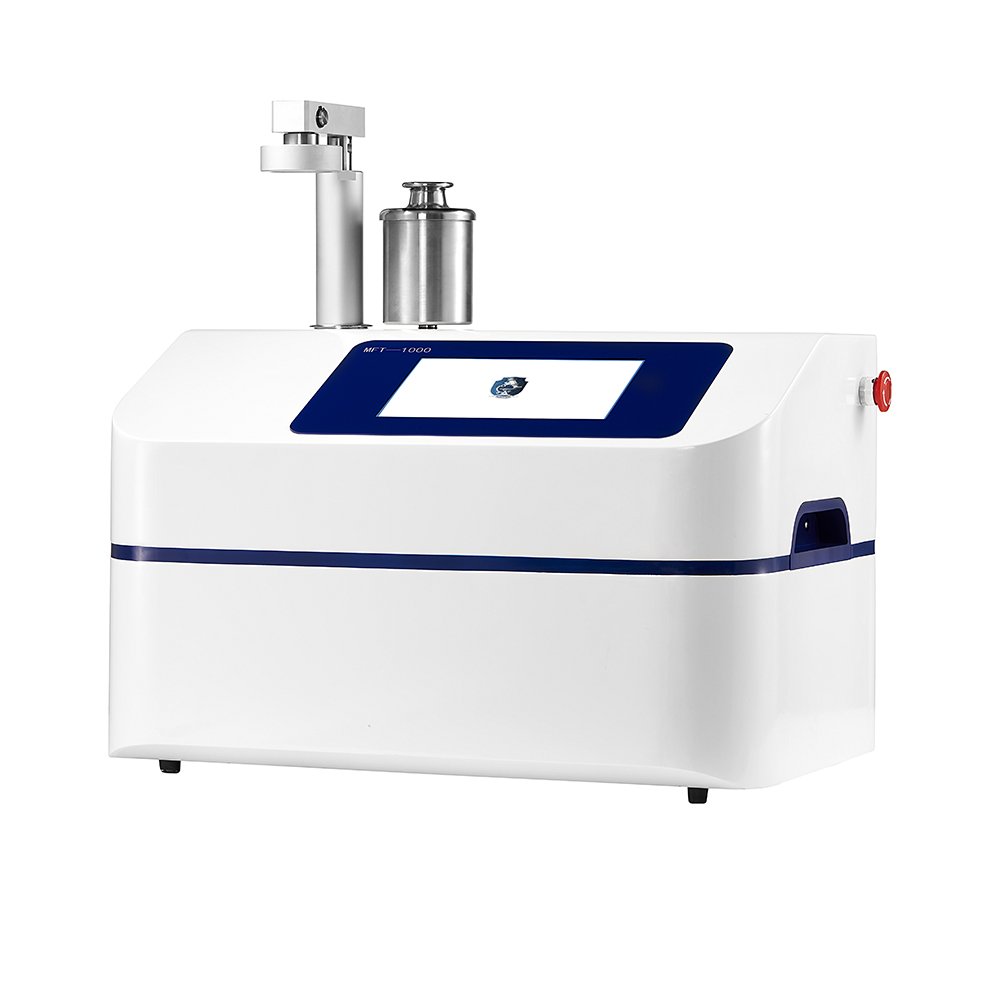
Die MedIntegrity MFT-1000 Packaging Leak Tester is intended for sealing-integrity testing of pharmaceutical packaging, including PFS, cartridges, vials, ampoules, BFS, and FFS. It supports vacuum attenuation and pressure attenuation methods. The published specification lists 0.00057 sccm test sensitivity and a 1.5 μm minimum detectable aperture.
Those figures are useful for initial screening. For QA and validation teams, however, cavity fit, method setup, calibration, record control, and support for additional package formats have just as much influence on whether the system works well in routine use.

Custom PFS Test Cavities for Package-Specific Methods
The MFT-1000 supports test cavities customized to the customer’s product, along with new-sample mold customization and method-parameter development and verification services.
A new PFS project normally starts with package dimensions, fill condition, closure configuration, expected test volume, and the target leakage requirement if available. Representative samples can then form the basis for cavity design and method work.
If another syringe or cartridge format is already planned, including it in the same technical discussion can make future tooling cost easier to assess before the purchase is finalized.
Once the package-specific method is established, the focus shifts from feasibility to controlled day-to-day operation.
Audit Trails, User Access, and Data Retention for Routine QC
The MFT-1000 includes automatic leak-flow calibration, four-level user authority management, USB data export, Ethernet/USB/RS485 interfaces, and at least five years of historical-record and audit-trail storage.
In daily QC, these functions have practical value. User levels help control method changes. Historical records make previous results easier to retrieve during investigations or quality review. Automatic leak-flow calibration can reduce manual work around routine checks.
If the tester needs to connect with an existing data environment, interface compatibility and data-transfer requirements still need to be confirmed during the project.
Application fit is only one part of a purchase decision. Once the required configuration is clear, the MFT-1000 can be benchmarked against other CCIT platforms using the same technical and commercial criteria.
MFT-1000 vs Established Global CCIT Platforms
Sepha and Bonfiglioli Engineering are established suppliers in pharmaceutical container closure integrity testing, making their benchtop platforms useful references during supplier evaluation. A fair comparison looks at package fit, test method, tooling, data control, implementation support, and service rather than relying on the smallest published defect size.
Comparing Sensitivity, Tooling, Data Control, and Service
| Platform | Published capability | Procurement focus |
| MedIntegrity MFT-1000 | Vacuum/pressure attenuation; 1.5 μm minimum detectable aperture | Custom cavity, method support, data control, application fit |
| Sepha Multi-Q HD | Vacuum decay; as low as 1 μm depending on container and contents | PFS compatibility, attachments, connectivity, data handling |
| Bonfiglioli LT-Pro | Vacuum/pressure decay; 1 μm or 5 μm configurations | Interchangeable tooling, feasibility testing, connectivity, remote support |
The Multi-Q HD offers published sensitivity as low as 1 μm for suitable applications, while the LT-Pro combines vacuum and pressure decay with interchangeable tooling.
For MedIntegrity, the practical advantage is the package-specific support around the test itself. The MFT-1000 uses customized test cavities and is supported by new-sample mold customization, method-parameter development and verification, and standard leak-rate or annual leak verification services. It also includes four-level user management, audit-trail storage, historical records, and multiple data interfaces.
For a PFS project, this gives procurement and validation teams a clearer path from representative samples to tooling, method setup, verification, and routine QC. The final choice still depends on the actual syringe, target leakage requirement, throughput, data environment, and future package formats.
Schlussfolgerung
GLP-1 packaging brings strong search interest to prefilled syringes, but the equipment decision still comes down to pharmaceutical packaging fundamentals. Reliable prefilled syringe leak testing depends on the actual PFS, a defined leakage requirement, a suitable chamber, stable method parameters, and data controls that fit routine QC.
For teams sourcing a Verpackungsleckagetester, the MFT-1000 offers PFS compatibility, custom test cavities, vacuum and pressure attenuation, method-development support, and long-term record functions that can be evaluated against a specific application.
If you are qualifying a new PFS, adding another package format, or reviewing an existing CCIT method, Kontakt MedIntegrity with the package dimensions, fill condition, closure configuration, expected test volume, and target leakage requirement to discuss feasibility, tooling, and quotation scope.
FAQ (häufig gestellte Fragen)
Q1: What is the best leak testing method for prefilled syringes?
A: There is no single best method for every PFS. Vacuum decay is a common non-destructive option, but package geometry, contents, closure design, target leakage limit, chamber configuration, and required sensitivity all affect method suitability.
Q2: What leak size does a prefilled syringe leak tester need to detect?
A: Required sensitivity comes from the package-integrity requirement and qualified method, not from a universal micron value. Published micron figures help shortlist equipment, but actual PFS performance needs evaluation under relevant test conditions.
Q3: How do I choose a packaging leak tester for PFS applications?
A: Compare package compatibility, repeatability, suitable sensitivity, cavity design, test time, verification, data controls, method support, training, service, and future tooling cost.
Q4: Can one packaging leak tester handle different syringe sizes and cartridges?
A: Potentially, if the platform supports those package types and suitable tooling is available. The MFT-1000 lists both PFS and cartridges among its applications and supports customized test cavities.
Q5: What information is needed to quote a PFS packaging leak tester?
A: Include package type and dimensions, fill condition, closure configuration, target leakage requirement if defined, expected test volume, data requirements, and any future package formats.
 German
  English
  Russian
  Spanish
  Portuguese
  French
  Italian
  Arabic
  Dutch
Dutch  Japanese
  Vietnamese
  Korean
  Malay
Malay  Thai
Thai