

Single vs Dual-Layer PES Filter Cartridges in 2026: Cost, Capacity, and Sizing
Single vs Dual-Layer PES Filter Cartridges in 2026: Cost, Capacity, and Sizing
A 0.2 micron filter may look like a standard catalog item. In pharmaceutical production, it rarely is.
Two cartridges can carry the same nominal pore rating but perform differently once they meet the actual process liquid. One maintains a stable flow through the full batch. Another starts well, then the differential pressure rises quickly and production has to stop.
For procurement teams and process engineers, the useful comparison goes beyond unit price. Membrane construction, usable capacity, filtration time, product hold-up, integrity testing, and documentation all affect the final purchase decision.
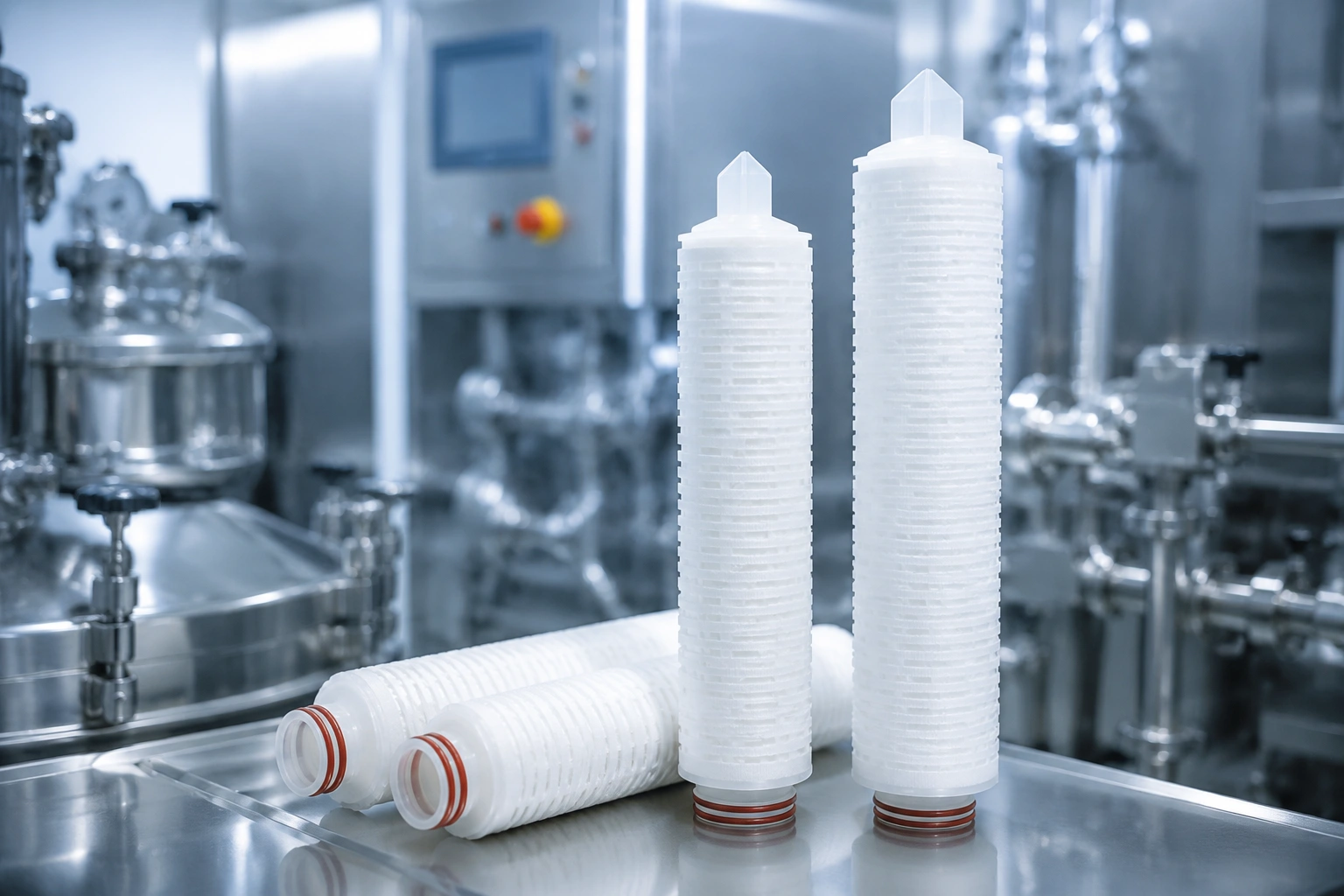
Single-Layer and Dual-Layer PES Filter Designs
When a Single-Layer PES Filter Fits the Process
A single-layer cartridge uses one primary PES membrane. It can be a practical choice for clear pharmaceutical liquids with stable incoming quality and effective upstream particle control.
Typical conditions include:
- Low and consistent particulate loading
- Moderate batch volume
- Slow differential-pressure increase
- An existing qualified prefilter
- No history of mid-batch cartridge replacement
- A process that values a simple flow path
In this type of application, adding another membrane layer may not deliver a measurable economic benefit. A single-layer PES filter can complete the batch with fewer configuration variables and a straightforward qualification plan.
When a Dual-Layer PES Filter May Add Capacity
A dual-layer cartridge contains two PES membrane layers. The role of each layer depends on the actual design.
Some dual-layer products use a more open upstream layer to capture part of the particle load before the liquid reaches the final membrane. Other products use the same membrane material in both layers but may differ in membrane geometry or pore arrangement.
The possible benefit is longer usable filtration time. When the upstream layer reduces the load reaching the final membrane, pressure may rise more slowly and the cartridge may process more liquid before reaching the operating limit.
That does not make dual-layer construction automatically better. It may add unnecessary cost when the liquid is already clean. The value becomes clearer when an existing filter plugs early, flow drops during the batch, or a cartridge change creates significant product loss.
Why a 0.2 Micron Rating Is Only the Starting Point
The label 0.2 micron filter describes nominal pore size, not complete process performance.
For pharmaceutical liquid filtration, buyers also need to evaluate:
- Compatibility with the formulation
- Operating temperature and pressure
- Maximum filtration time
- Flow behavior
- Product adsorption and hold-up
- Sterilization conditions
- Integrity-test limits
- Supporting qualification documents
A cartridge that fits the housing and carries the correct pore rating is not automatically equivalent to the filter already used in production.
This point matters during second-source qualification. A new cartridge can have the same length, adapter, seal, and nominal pore size yet produce a different pressure curve with the same liquid. The difference may not appear in a standard water-flow test.
MedIntegrity PES Filter Cartridge
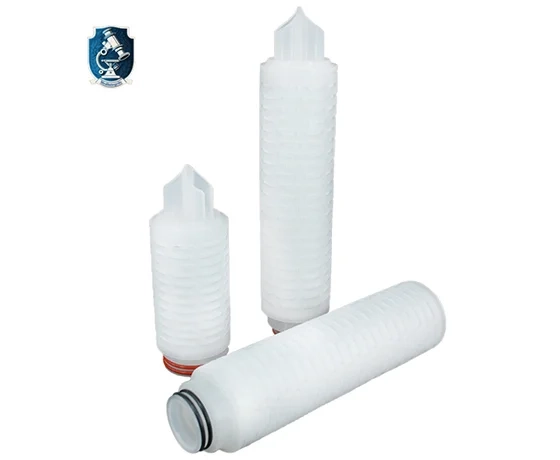
El MedIntegrity PES filter cartridge uses a hydrophilic asymmetric sulfonated PES membrane and is available in single-layer and dual-layer configurations.
Published pore-size options include 0.1, 0.2, 0.45, 0.65, 0.8, 1.2, and 3.0 µm. Available cartridge diameters include 69 mm, 83 mm, and 130 mm. The cartridge uses PES filtration media with polypropylene support and structural components, and the assembly is melt sealed.
Published operating limits include:
- Maximum working condition of 90°C at 0.20 MPa
- Steam sterilization at 121°C for 30 minutes
- Maximum forward differential pressure of 0.40 MPa at 25°C
- Maximum reverse differential pressure of 0.21 MPa at 25°C
Each cartridge is individually numbered and linked to a traceable production batch. MedIntegrity also performs an integrity test on every cartridge before shipment. These controls support incoming inspection and batch documentation, but they do not replace the user’s process qualification or pre-use and post-use integrity-testing program.
The product page states that both layers in the dual-layer version use the same membrane material. Buyers need to confirm the exact pore configuration, cartridge length, adapter, seal material, effective filtration area, and recommended integrity-test limits during technical review.
MedIntegrity also provides HPP, PTFE, capsule-filter, and housing options within its broader cartridge filter and housing range. This gives pharmaceutical buyers a route to discuss upstream clarification, final liquid filtration, cartridge format, and housing compatibility within one sourcing project.
Single-Layer vs Dual-Layer Procurement Comparison
| Evaluation point | Single-layer PES cartridge | Dual-layer PES cartridge |
| Typical process fit | Clear, low-fouling liquid | Liquid with variable or higher fouling tendency |
| Initial flow | May be favorable in clean fluids | Depends on membrane arrangement |
| Pressure behavior | Relies heavily on feed quality and upstream control | May slow pressure rise in a suitable application |
| System complexity | Simpler configuration | Additional membrane layer |
| Main commercial risk | Early plugging may erase unit-price savings | Added cost may bring little value in a clean process |
| Key evaluation | Flow and pressure stability | Capacity, pressure rise, and changeout reduction |
This table is a screening tool, not a validation conclusion. Final selection depends on representative liquid testing.
For buyers still comparing filter formats, MedIntegrity’s guide to capsule filters versus cartridge filters provides additional context on installation, reusable housings, batch scale, and long-term operating cost.
Compare Cost per Batch, Not Cartridge Price
The lowest cartridge quotation does not always produce the lowest filtration cost.
A realistic commercial comparison includes:
- Number of cartridges used per batch
- Separate prefilter requirements
- Flushing and conditioning volume
- Product retained in the cartridge and housing
- Filtration time
- Operator labor
- Integrity-testing time
- Changeout and disposal costs
- Production interruption risk
- Qualification and documentation work
Consider a process in which the terminal filter reaches its pressure limit before the full batch is complete. The replacement cartridge is only part of the added cost. Production also loses time during changeout, more liquid remains in the removed assembly, and the team may need another integrity test and a deviation review.
On the other hand, buying a higher-cost dual-layer cartridge for a clean, low-volume formulation may add no practical return.
This is why unit price needs context. The better commercial question is:
How much qualified product can the selected cartridge process before reaching the defined pressure, flow, or time limit?
How to Size a PES Filter Before Purchase
Test with Representative Process Liquid
Clean-water flow data works for an initial comparison, but it cannot reproduce formulation viscosity, suspended material, temperature, or membrane interaction.
Use the actual process liquid where feasible. A justified surrogate can work when the commercial formulation is unavailable, provided its filtration behavior is reasonably comparable.
A short screening test often reveals more than a long specification sheet. It shows whether pressure stays flat, climbs gradually, or rises sharply after a certain processed volume.
Record Pressure and Capacity Data
A practical filterability study records:
- Initial flow rate
- Initial differential pressure
- Pressure rise against processed volume
- Flow decline over time
- Total throughput at the selected endpoint
- Product recovery
- Cartridge and housing hold-up
- Integrity-test results before and after processing
Define the stop point before starting the test. It may be the maximum permitted differential pressure, minimum acceptable flow, or maximum filtration time.
The same endpoint must be used when comparing single-layer and dual-layer cartridges. Otherwise, the capacity figures will not be commercially meaningful.
Include a Scale-Up Margin
A laboratory result does not transfer directly to production without a margin.
Feed quality can shift between batches. Temperature may vary. Pumps and piping also affect actual pressure. A documented scale-up factor gives the production filter enough capacity to complete the batch without operating close to the limit.
The margin cannot be fixed for every process. It comes from the test method, variability of the liquid, filtration risk, and site qualification strategy.
Integrity Testing as Part of the Filter Purchase
Factory testing confirms that the cartridge passed the manufacturer’s release criteria before shipment. Production use still requires an integrity-testing approach tied to the selected filter and process.
MedIntegrity Testador de Integridad de Filtro V10 supports multiple integrity-test methods, allowing pharmaceutical teams to evaluate different membrane and filter-system requirements within one testing platform.
When reviewing a cartridge proposal, confirm:
- Recommended wetting fluid
- Test method
- Test pressure
- Stabilization time
- Pass/fail limit
- Relationship between the integrity limit and the proposed cartridge
- Test conditions before and after processing
A physical fit alone is not enough for replacing another supplier’s cartridge. The change needs technical comparison, filterability data, integrity-test criteria, and the buyer’s qualification and change-control process.
What a PES Filter Supplier Needs for an Accurate Quotation
A request such as “10-inch, 0.2 micron, best price” leaves too many variables open.
For a useful proposal, provide the PES filter supplier with:
- Process liquid
- Batch volume
- Viscosity
- Operating temperature
- Target flow rate
- Available pressure
- Required pore size
- Cartridge length and diameter
- Adapter type
- Seal material
- Sterilization cycle
- Current filter reference
- Required technical documents
- Annual consumption
- Delivery schedule
Integridad médica operates as a manufacturer with its own production base and supports configuration discussions and customization when customer and regulatory requirements can be met. Its service scope also includes product training, operation guidance, maintenance support, and technical consultation.
That direct communication can be useful when the project involves nonstandard dimensions, seal requirements, documentation scope, or staged sample evaluation.
Conclusión
A single-layer PES filter can be the more practical purchase for clear pharmaceutical liquids with stable pressure behavior and effective upstream control. A dual-layer 0.2 micron filter may deliver better batch economics when fouling, rapid pressure rise, or cartridge changeouts are already affecting production.
The right choice comes from representative testing, documented integrity criteria, and a like-for-like commercial review. MedIntegrity offers single-layer and dual-layer PES cartridges, multiple pore-size options, traceable cartridge identification, pre-shipment integrity testing, related housings, and integrity-testing equipment.
Contact MedIntegrity for a configuration review and quotation with your process liquid, batch volume, pressure range, sterilization conditions, cartridge dimensions, current filter reference, annual demand, and required documentation.
Preguntas frecuentes
Q1: Does a 0.2 micron filter automatically qualify as sterilizing-grade?
A: No. Nominal pore size is only one element. Qualification also depends on microbial-retention evidence, formulation compatibility, process conditions, and integrity-test limits linked to the selected cartridge.
Q2: How do I choose between a single-layer and dual-layer PES filter?
A: Start with the liquid’s fouling behavior and the current pressure curve. A single-layer cartridge may suit clear liquids with stable flow, while a dual-layer design may add value when the final membrane plugs early.
Q3: How much liquid can a 10-inch PES filter process?
A: There is no universal volume. Capacity varies with viscosity, particulate loading, temperature, operating pressure, membrane construction, target flow, and the defined stop criterion.
Q4: What information does a PES filter supplier need for an accurate quotation?
A: Provide the liquid type, batch volume, viscosity, flow target, pressure limit, pore size, cartridge dimensions, adapter, seal material, sterilization cycle, current filter model, document requirements, annual quantity, and delivery target.
Q5: Can a MedIntegrity cartridge replace a Sartorius, Merck, or Pall cartridge?
A: Matching pore size and physical dimensions do not establish technical equivalence. Compare membrane structure, flow, capacity, seals, sterilization limits, integrity-test criteria, documentation, and representative process-liquid performance before completing change control.

 Spanish
  English
  Russian
  Portuguese
  German
  French
  Italian
  Arabic
  Dutch
Dutch  Japanese
  Vietnamese
  Korean
  Malay
Malay  Thai
Thai