

Filter Integrity Tester Testing Methods: Water Intrusion Test (WIT) – Principles, Applicable Filter Types, and Testing Procedures
Filter Integrity Tester Testing Methods: Water Intrusion Test (WIT) – Principles, Applicable Filter Types, and Testing Procedures
过滤器完整性测试仪广泛应用于无菌制药生产中。根据膜材料、亲水或疏水特性以及具体工艺应用的不同,需要采用不同的测试方法来评估过滤器的完整性。常用的方法包括气泡点测试、扩散流测试、压力保持测试和水侵入测试。
在本文中,我们将重点介绍专门为疏水过滤器设计的方法之一:水侵入测试 (WIT)。
与气泡点测试和扩散流测试不同,水侵入测试无需预先用低表面张力液体(例如酒精)润湿膜。它利用疏水性膜的防水特性,并在特定的测试条件下监测相关变化,从而评估过滤器的完整性。
水侵入测试是如何进行的?哪些类型的过滤器适用于这种方法?用户在测试过程中应该注意什么?
1. 什么是渗水测试?
水侵入测试(通常缩写为 WIT)是一种主要用于疏水膜过滤器的过滤器完整性测试方法。
疏水膜具有相对较低的表面能,这使得水难以润湿其孔隙。在特定的压力范围内,水难以轻易进入完整疏水膜的孔隙。这一特性可用于完整性测试:在过滤器的一侧注入水,并施加特定的气体压力。通过监测测试过程中与水渗入相关的变化,可以评估膜和过滤器组件的完整性。
在常规应用中,水侵入测试主要用于疏水性气体过滤器,例如压缩空气过滤器、工艺气体过滤器和储罐通风过滤器。
需要注意的是,水侵入测试并非适用于所有类型过滤器的通用方法。其测试原理和参数取决于多种因素,例如膜的疏水性、有效过滤面积、滤芯设计和系统配置。因此,应根据过滤器制造商提供的验证程序和技术规范选择测试方法和参数。
2. 水侵入试验的工作原理
水侵入测试是基于疏水膜抵抗水渗透的能力。
疏水膜的孔隙不易被水润湿。当水接触到膜时,表面张力和毛细作用力会阻止水轻易渗入孔隙。因此,在特定的测试压力条件下,进入完整疏水膜的水量始终有限。
测试过程中,过滤器按照预设配置连接到测试系统。水从过滤器的一侧注入,同时在气体侧施加设定的气体压力。经过适当的稳定期后,仪器监测相关参数,例如压力变化或气体补偿流量,并将测量结果与预设的验收限值进行比较。
当膜和过滤器组件保持完好时,测得的与渗水相关的数值通常会保持在规定的限值范围内。如果膜损坏、密封失效或存在其他异常情况,渗水行为可能会发生变化,从而导致测量结果超出可接受的限值。
需要注意的是,渗水测试并非仅仅检测水是否能够穿过膜,而是定量测量在特定测试条件下与渗水相关的各项参数。
不同的仪器可能采用不同的测量方法(例如压力衰减法或气体补偿流量法)来获取测试数据。因此,具体的测试原理、压力、稳定时间和验收限值应根据仪器设计和过滤器制造商已验证的程序来确定。
3. 哪些过滤器适用于渗水测试?
水侵入测试主要适用于具有疏水性的膜过滤器。
膜材料是选择测试方法时需要考虑的重要因素。然而,仅凭材料类型不足以判断特定过滤器是否适用。还必须考虑膜的结构、疏水性以及制造商验证过的完整性测试方法。
1)疏水性聚四氟乙烯过滤器
聚四氟乙烯(PTFE)是制药气体过滤中常用的疏水性膜材料。它具有良好的防水性能,广泛应用于气体灭菌和通风过滤领域。
例如,安装在制药生产设备、储罐和工艺管道上的通风过滤器可能使用疏水性聚四氟乙烯(PTFE)滤芯。当特定过滤器通过水侵入测试验证后,即可按照制造商规定的程序评估其完整性。
2)疏水性PVDF过滤器
聚偏二氟乙烯(PVDF)膜有亲水性和疏水性两种类型。某些疏水性PVDF过滤器用于气体过滤和其他特殊工艺应用。
仅凭材料名称无法判断PVDF滤芯是否适用于水侵入测试。必须审查其表面处理、孔隙结构、疏水性以及制造商的验证数据。
3)其他疏水膜过滤器
某些材料,包括聚乙烯(PE),也可用于制造疏水性过滤介质。然而,不同产品的过滤结构和性能特征可能存在显著差异。
只有当制造商提供相应的测试方法和验收标准时,该过滤器才应被视为适合进行渗水测试。
一般来说,水侵入测试适用于疏水性膜过滤器,特别是用于气体消毒和通风过滤应用的疏水性膜过滤器。
对于亲水性膜过滤器,如 PES 和尼龙过滤器,一般根据过滤器设计和制造商的建议选择其他方法,包括气泡点测试和扩散流测试。
4. 水侵入试验、气泡点试验和扩散流试验之间有什么区别?
气泡点测试、扩散流测试和水侵入测试都是常用的过滤器完整性测试方法。然而,它们的运行原理和适用的过滤器类型各不相同。
气泡点测试
气泡点测试主要针对润湿良好的膜进行。测试过程中,膜孔内充满润湿液。逐渐增加过滤器一侧的气体压力。当压力达到一定水平时,气体开始将润湿液从最大的膜孔中排出。
该仪器利用气体突破时的压力来评估膜的完整性。
气泡点测试通常用于亲水性灭菌级膜过滤器,包括经过验证的 PES、PVDF 和尼龙过滤器。
扩散流试验
扩散流动测试通常也是在预润湿膜上进行的。在低于泡点压力的测试压力下,气体通过充满液体的膜孔扩散。
该仪器测量指定压力下的气体扩散流量,并将结果与预定义的验收限值进行比较,以评估过滤器的完整性。
这种方法常用于亲水性膜过滤器。
水侵入测试
水侵入测试主要用于疏水性膜过滤器。测试过程中,膜通常保持干燥,无需预先用低表面张力液体润湿。
该仪器在特定压力条件下监测与水侵入相关的参数,以评估过滤器的完整性。
以下总结了这三种方法的主要区别: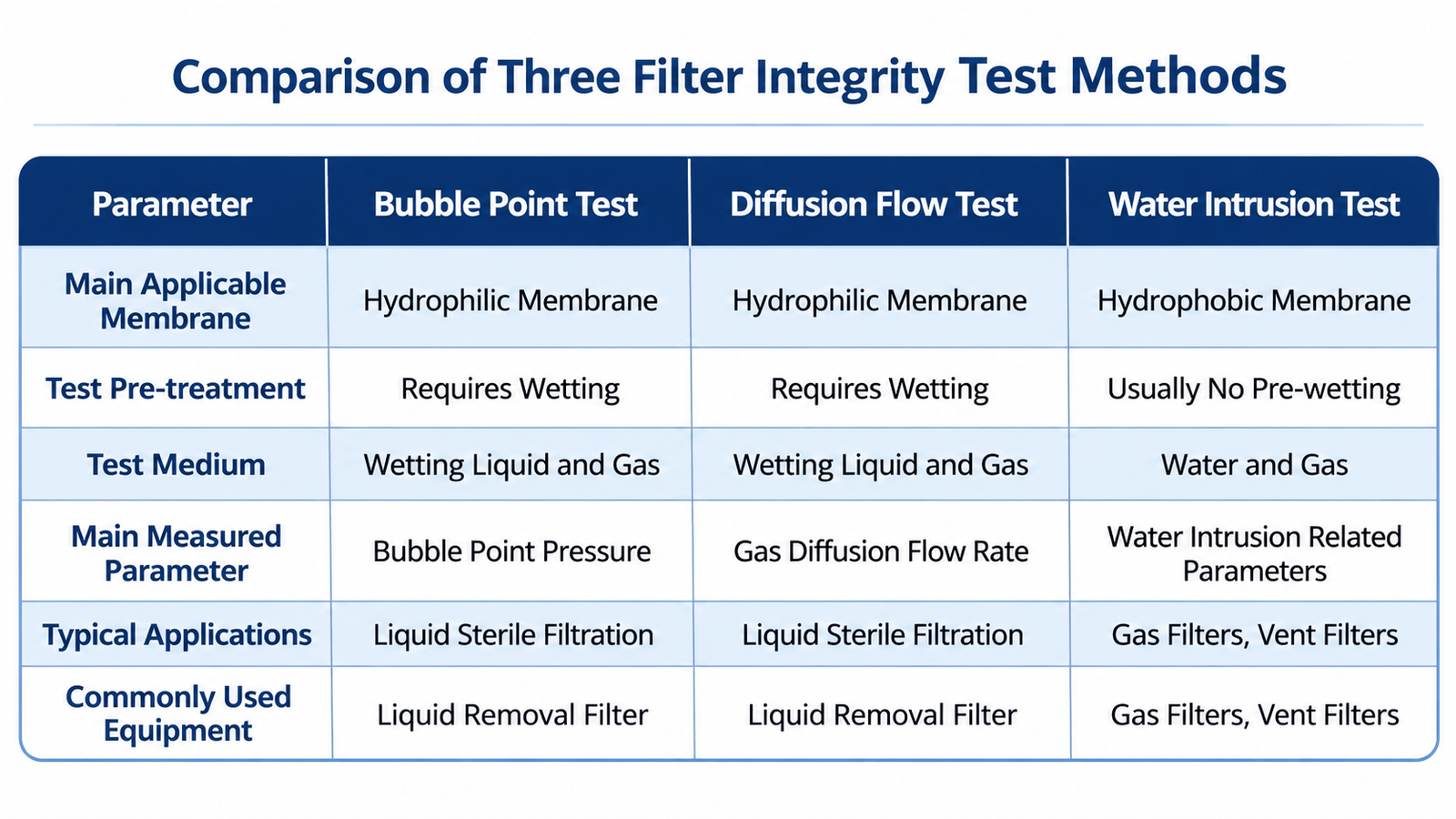
需要强调的是,这些只是典型应用案例。这并不意味着某种特定的膜材料只能用一种特定方法进行测试。实际测试方法的选择应基于过滤器制造商的验证数据、过滤器设计以及具体的工艺要求。
5. 渗水测试程序和关键注意事项
The specific Water Intrusion Test procedure depends on the filter configuration, testing instrument, and manufacturer’s instructions. The following steps outline the key stages that should generally be considered.
1) Confirm the Filter and Test Method
Before testing, verify the filter model, membrane material, filtration area, pore size, and applicable integrity testing method. Confirm that the filter has been validated for the Water Intrusion Test and that the selected instrument supports the required test mode.
2) Check the Filter Installation
Install the filter cartridge in its housing according to the assembly instructions. Inspect the sealing rings, connections, and interfaces to ensure that the filter is properly installed.
Incorrect installation or inadequate sealing may affect the test results.
3) Introduce Water as Specified
Introduce water on the designated side of the filter according to the filter manufacturer’s test procedure, ensuring that the testing system is correctly connected.
Water quality, temperature, and the condition of the equipment before testing should be controlled to minimize potential interference with the measurement.
4) Set the Test Parameters
Configure the test pressure, stabilization time, test duration, and acceptance limits according to the validated procedure for the specific filter model.
Test parameters should not be applied universally across filters with different specifications or designs.
5) Perform the Test and Monitor the Data
Start the test. The instrument will control the pressure according to the programmed procedure and monitor the relevant parameters.
During testing, avoid unnecessary adjustments to the connections or interruptions to the test process, as these may affect data reliability.
6) Evaluate the Test Results
After the test is completed, compare the measured results with the acceptance criteria specified for the filter.
If the results fall within the defined limits, the test can be considered passed. If the results exceed the limits, investigate possible causes, including filter installation, sealing conditions, test parameters, and filter condition. Repeat testing only when justified and in accordance with the established procedure.
In actual operation, test pressure, test duration, and acceptance limits should always be based on validated procedures rather than being independently determined by the operator.
6. Common Factors That May Affect Water Intrusion Test Results
The Water Intrusion Test requires appropriate test conditions and a stable testing system. Several factors may influence the results.
Membrane Surface Condition and Moisture
Contamination, cleaning agent residues, or other substances on a hydrophobic membrane may alter its surface properties and affect its water intrusion behavior.
Test Temperature
Temperature variations may affect water surface tension, vapor pressure, and gas behavior. Therefore, the testing environment and water temperature should comply with the requirements of the validated procedure.
System Sealing
Inadequate sealing between the filter and housing, or leakage at pipeline connections, may result in abnormal measurements. These components should be inspected before testing.
Filter Size and Effective Filtration Area
Different filters have different structures, filtration areas, and internal volumes. Their test parameters and acceptance limits may therefore vary. The test procedure should be appropriate for the specific filter configuration.
Instrument Measurement Performance
The Water Intrusion Test involves measuring relatively small changes in relevant parameters. It places certain requirements on pressure control, flow measurement, and system stability.
The testing instrument should have the measurement capabilities required for the application and should be calibrated and maintained according to the applicable procedures.
7. How to Select a Filter Integrity Tester That Supports the Water Intrusion Test
For pharmaceutical manufacturers that need to perform integrity testing on hydrophobic gas filters, selecting a suitable Filter Integrity Tester involves more than simply confirming whether the instrument supports the Water Intrusion Test.
Several factors should be considered.
First, confirm whether the instrument supports the testing methods required for the filters used in the facility, including the Bubble Point Test, Diffusion Flow Test, and Water Intrusion Test. The available methods should be compatible with the validated procedures provided by the filter manufacturers.
Second, evaluate the instrument’s pressure control capability, measurement range, accuracy, and test repeatability to ensure that it meets the requirements of the specific filter applications.
Data management is another important consideration when selecting testing equipment for pharmaceutical manufacturing. For GMP-regulated production and quality control environments, manufacturers should assess whether the instrument provides functions such as user access management, audit trails, historical data review, and data export, in accordance with their computerized system requirements.
For facilities that use both hydrophilic liquid filters and hydrophobic gas filters, selecting a Filter Integrity Tester that supports multiple integrity testing methods can help standardize routine testing procedures and accommodate different filtration applications.
Conclusion
The Water Intrusion Test is an important method for evaluating the integrity of hydrophobic membrane filters. It has practical applications in pharmaceutical gas sterilization, tank vent filtration, and related processes.
与气泡点测试和扩散流测试相比,渗水测试利用疏水膜的防水特性来评估过滤器的完整性,无需传统的预润湿步骤。然而,其适用的过滤器类型、测试参数和验收标准必须根据具体的过滤器及其已验证的测试程序来确定。
在制药生产中,过滤器完整性测试是无菌过滤过程中质量控制的重要组成部分。无论是液体除菌过滤、压缩空气过滤、工艺气体过滤还是储罐排气过滤,根据过滤器类型和工艺要求选择合适的完整性测试方法都至关重要。
合适的滤波器完整性测试仪应提供不同滤波器应用所需的测试功能,同时支持可靠的测量和有效的数据管理。
如需了解有关过滤器完整性测试仪和药品过滤完整性测试的更多技术文章和实用信息,请关注我们以获取最新资讯。
 English
 Russian
 Spanish
 Portuguese
 German
 French
 Italian
 Arabic
 Dutch
 Japanese
 Vietnamese
 Korean
 Malay
 Thai